
Justin Fields might be good
Russ who?
Three games do not a career resurrection make, but it’s tough for the Justin Fields Experiment to have gone any better so far, for both player and team. The quarterback whose 10-28 record in Chicago suffocated any of the spectacular plays he made along the way looks like a changed man with the Steelers.
Sure, we’re only three weeks in, and there aren’t too many examples of highly-drafted quarterbacks washing out in their first stop and finding major success elsewhere, but Fields’ youth and jaw-dropping physical gifts make it tempting to believe.
I’m surprised to be saying this, given that I was firmly of the opinion that Russell Wilson gave the Steelers the best chance to win this year. I thought the scar tissue from Fields’ tenure in Chicago needed time to heal, if it even did at all.
That didn’t seem like a controversial opinion, either. Wilson was coming off a 26-touchdown, 8-interception season in Denver, one where he was benched primarily because he and Sean Payton didn’t see eye-to-eye, and Payton wanted the chance to draft and mold a young quarterback.
Wilson wasn’t exceptional in Denver, but he was good enough to beat the Packers, Chiefs and Bills in succession last year, throwing 6 touchdowns and no interceptions in the process. Is that cherry-picking three games from his best stretch of the season? Absolutely. But the ability was still in there.
By all accounts, the Steelers’ plan was to have Wilson and Kenny Pickett compete for the starting job, with Wilson having the inside track. Then Pickett went and – according to what I was told – requested a trade. This all moved rapidly; Wilson was signed on March 11th, Pickett was traded on the 15th, and Fields was acquired on the 16th.
It was not lost on anyone involved that Fields was had for a conditional sixth-round pick. The minimal acquisition cost was the byproduct of a few factors; everyone knew the Bears were taking Caleb Williams, undercutting some of their leverage, and additionally, a bidding war for Fields’ services never broke out. Despite his obvious talent, and the occasional game where said talent was on full display, no team was willing to beat everyone else to the punch.
Wilson’s calf injury – suffered during a conditioning test – opened the door for Fields to run with the first team at camp. There were some, myself included, who wondered if the Steelers weren’t deliberately slow-playing Wilson’s recovery in order to get a better handle on Fields in advance of a possible bridge contract offer. That never materialized, and when Wilson finally got right, he took back over as the starter.
One calf aggravation later, and Fields was the man heading into Week 1. Some Steelers fans seemed excited by that; I was apprehensive. Three weeks later, it seems excitement was the right emotional response. And Wilson? Even if he’s ready next week, I don’t think he’s getting his job back.
If the major knocks against Fields during his time with the Bears were that he turned the ball over too much, failed to manage games well, didn’t utilize the middle of the field, and wasn’t accurate enough, he’s spent his first three games dispelling them.
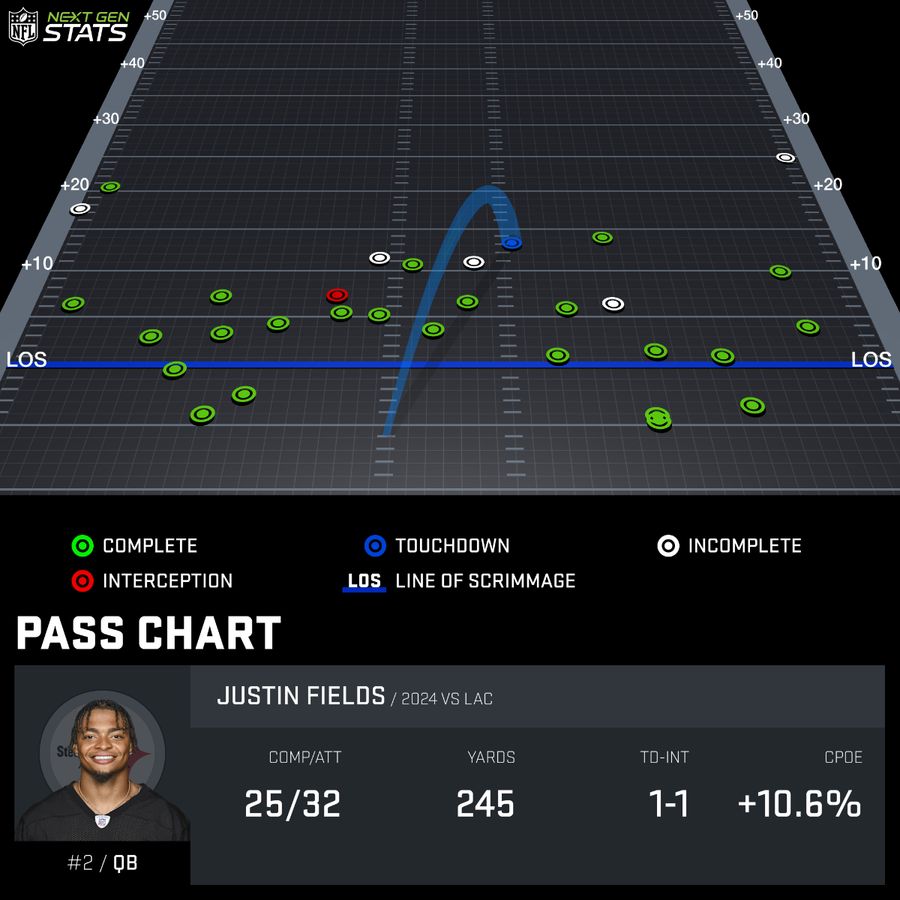
He’s committed just one turnover in three weeks, an interception against the Chargers that didn’t hurt the Steelers. He has, on numerous occasions, checked down or even taken a sack instead of force a ball up in an effort to make a hero-ball play. His legs, very much a known commodity, were a big factor against the Falcons in Week 1.
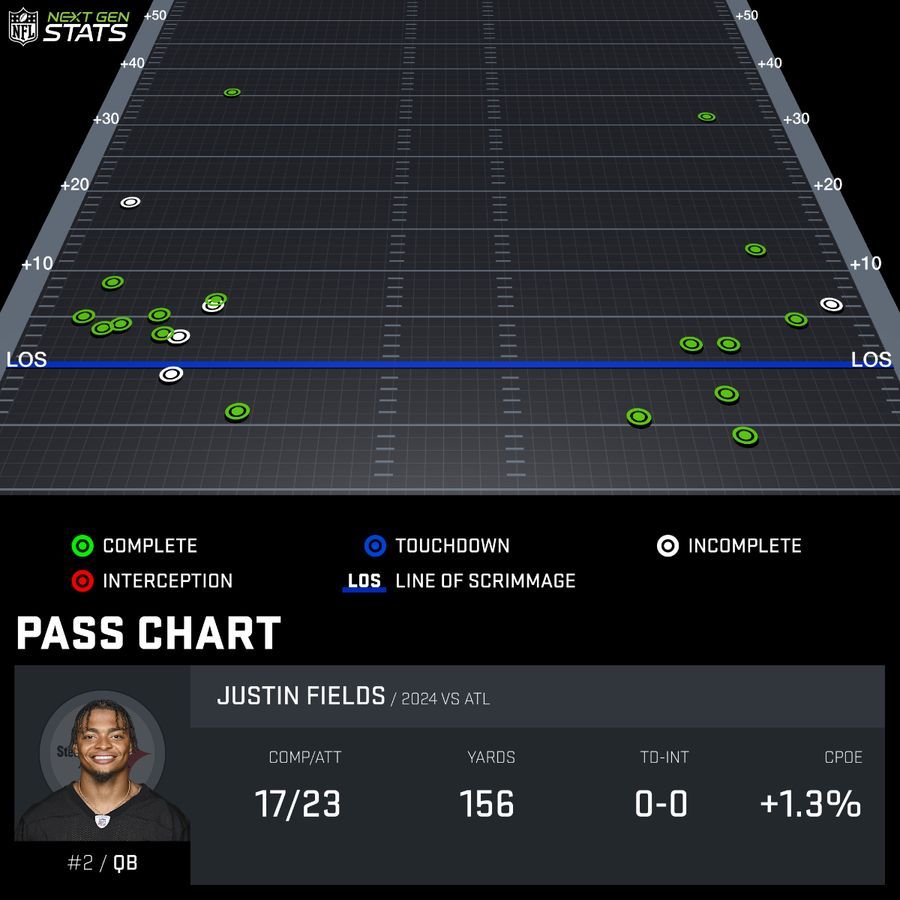
It’s the middle of the field usage and the accuracy, though, that have piqued my interest. Fields’ passing charts over at Next Gen Stats paint a picture of a quarterback evolving week after week, even if the leaps forward aren’t as dramatic as some would like.
Here’s Week 1, when the total absence of so much as an attempt inside the hashmarks drew chuckles from some corners of the NFL media landscape.
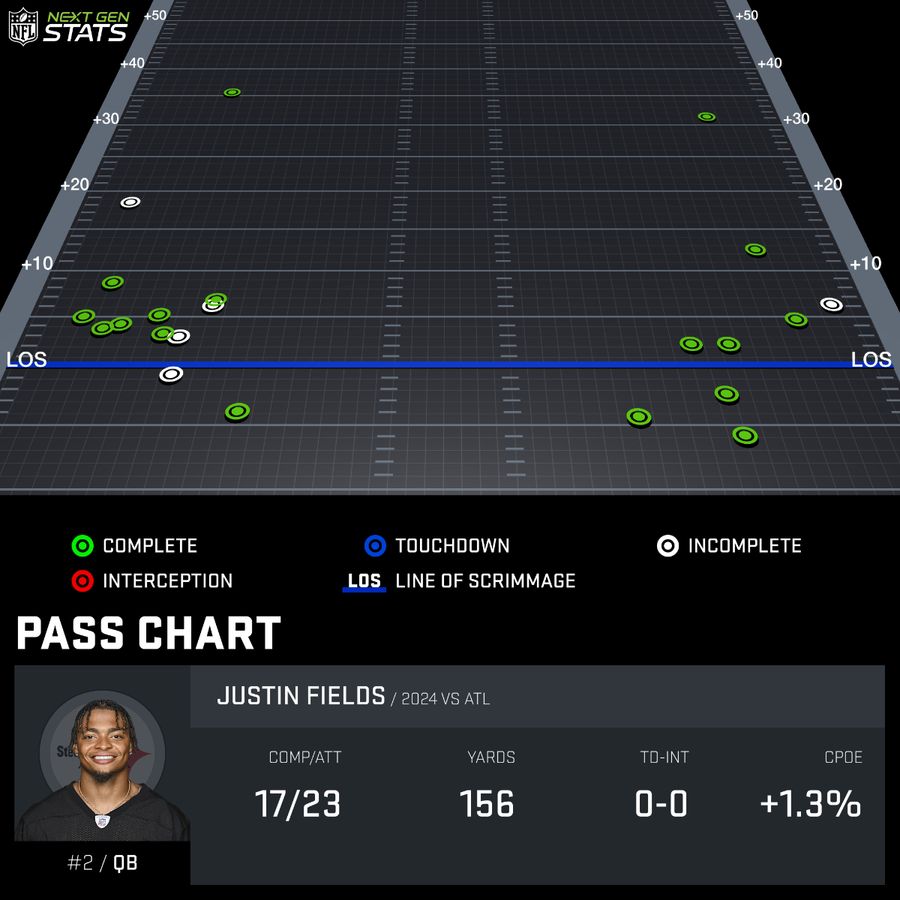
Week 2? A little better, but the majority of both the completions and attempts were still concentrated outside.
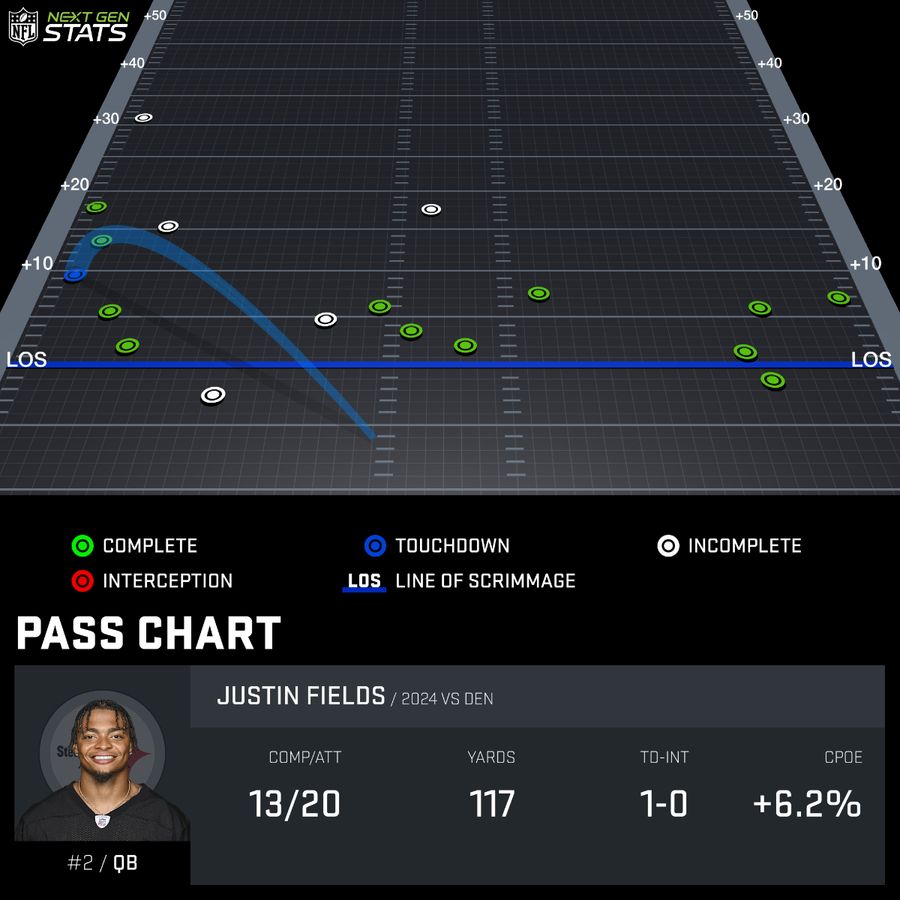
If Week 2 was a small step forward from Week 1, then Week 3 was several leaps. Fields peppered the middle of the field with attempts; many were short, but his 55-yard touchdown strike to Calvin Austin was a laser that traveled 13 yards beyond the line of scrimmage, and had to be driven in decisively to avoid a closing safety.
The Steelers’ hesitancy to test the middle of the field in Week 1 likely stemmed from Mike Tomlin’s preference to try and win ugly against Atlanta. He got away with it, because his defense was spectacular. The refrain was much the same in Week 2, as said defense totally destroyed an overmatched Bo Nix.
Thanks for reading Nine Straight Threes! This post is public so feel free to share it.
Week 3 was going to be a different story. The Chargers came swaggering in, a physically dominant group that wanted to play the kind of beat-em-up football that Tomlin loves. What’s more, they got ahead of the Steelers 7-0.
Finally, a test: How would Fields react when faced with a deficit against a good team, not to mention one with a fast, attacking defense? Quite well, as a matter of fact.
He immediately marched the Steelers 70 yards, mixing the run and pass, throwing a few passes between the hashmarks and then cruising in himself for a tying score. That was eye-opening. The second half was even better. There was a beauty of a throw to Austin for 25 yards on the drive that tied the game at 10, some more work over the middle on the go-ahead drive, and then the strike to Austin to put the game away.
Tony Romo, having a rare good day in the analyst’s chair for CBS, heaped praise on Fields all afternoon, and I have to agree with his assessment. He was patient, threw into the correct windows at the correct time, and did everything decisively.
That was another problem in Chicago; you could watch the highlights and be amazed at Fields’ speed, physicality, and beautiful deep passing, but the play-to-play consistency was lacking. That’s how you complete just 60 percent of your passes and go from 11th pick in the draft to traded in just three years.
Against Los Angeles, with the Steelers needing him to be their best offensive player, Fields delivered the goods. He’s completing 73.3 percent of his passes after Sunday’s performance, and he threw the ball like a guy full of confidence and conviction.
That’s a dangerous combination for someone with his raw ability. Fields and offensive coordinator Arthur Smith are clearly getting more comfortable with each other by the week, and if Tomlin has been watching what his young passer is doing, he’ll continue to allow him to open things up.
The Steelers might not need Fields to be spectacular to beat the Colts next week; Indy is banged up, and their prized passer, Anthony Richardson, is experiencing some growing pains of his own. When the Cowboys arrive in Week 5, however, Tomlin might need a star turn from his quarterback to win the game.
Fortunately for him, and the Steelers, it’s looking more and more like Justin Fields is capable of exactly that.